Plan a Utility Cart Around Its Parking Place and Actual Contents
A rolling cart is useful when it solves a specific movement problem and has somewhere to park. Begin with the activity, load and route. Test the idea with existing storage before deciding that another organizer belongs in the room.
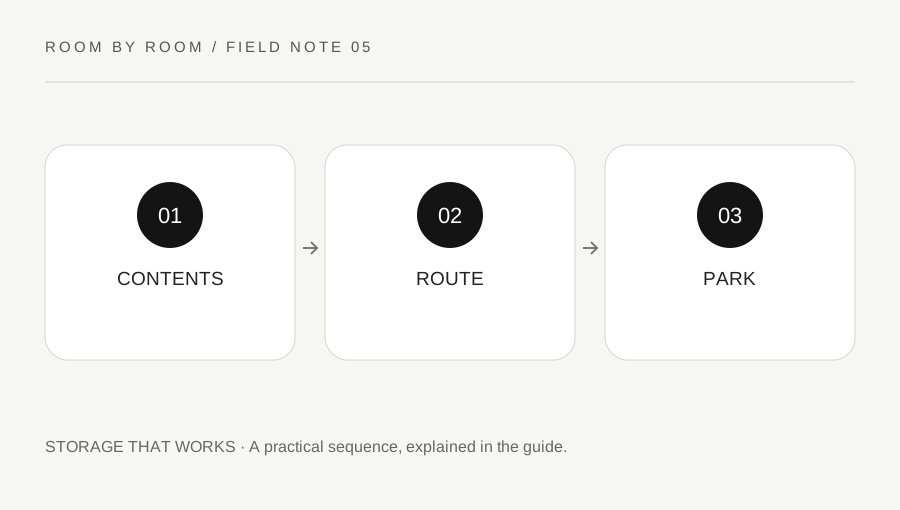
Original explanatory diagram. Examples illustrate a method or decision; they are not claims of personal testing.
Define the activity the cart would support
Name the materials and the two places between which they need to move. A mobile drawing kit and a household reference station have different contents and access needs. List the actual items, including the largest awkward piece. If nothing needs to move, a fixed accessible shelf may be the simpler solution.
Use what you already own to test the grouping. Put the intended contents together in an appropriate temporary container and observe which items you actually reach for during the activity. Do not assume that several attractive empty tiers will automatically create a useful category. A cart should support a real routine, rather than become another destination for objects that have no agreed home.
Choose a parking place before a route
Identify where the cart will stay when it is not in use. Check the usable floor area with the room's ordinary doors, drawers and chairs in operation. An apparent gap may be needed to sit down, reach a cupboard or pass through the room. Keep exits and required access available; a wheeled object can still become an obstruction when parked in the wrong place.
Mark the intended footprint with an appropriate removable method that does not damage the surface, or use a measured paper outline for a brief test. Avoid creating a trip hazard during the experiment. Walk through the normal activity and remove the marker afterward. Measure the real footprint of a candidate cart, including projecting handles, rather than relying on the width of its trays alone.
Check the actual product constraints
For any cart you already own or are considering, read its manufacturer instructions for load, assembly, surfaces and intended use. Check the arrangement of its wheels and any braking feature according to those instructions. Do not assume that every utility cart can safely carry the same weight or cross a threshold with its contents in place.
Keep loads appropriate and stable, and do not use a cart as a step or seat unless the product is specifically designed for that purpose. This article provides no engineering assessment or product recommendation. CPSC's broader furniture safety information is a background reference, while the exact product instructions control the cart's actual installation and use.
Work through an ordinary drawing-kit example
Imagine a person who draws at a shared table and stores materials in an adjacent room. Their proposed grouping contains a sketchbook, a small pencil case and a flat folder. They discover that the folder does not fit the candidate trays without bending, and that the suggested parking place interferes with a cupboard door.
They keep the sketchbook and pencil case in an existing suitable container and store the folder flat in an accessible location. A cart may still become useful later, but this test has not yet shown a clear advantage. The invented example illustrates a legitimate decision not to add furniture. A product that looks compact in a photograph is not evidence that it fits a particular route or activity.
Judge success by use and reset
If the actual cart suits the task and room, test moving and parking it under the manufacturer's instructions with an appropriate real load. Check whether the items remain easy to retrieve and return. Do not arrange frequently used objects behind a second layer merely to make the front view look tidy.
After several real sessions, review whether the cart remains within its intended task. Remove unrelated items with their owners' agreement and give them suitable homes. If the cart never moves or regularly blocks the room, reconsider its location or purpose. The useful result is an easier activity and a clear parking place, not a new storage object that requires a second organization system of its own.
A practical checklist
Choices are saved in this browser. Reset them here or clear this site’s browser storage.
Questions that come up
Is a cart always better than a shelf?
No. A fixed shelf may be simpler when the materials do not need to move. Choose according to the actual routine and space.
Can I ignore the handle when measuring?
No. Include the full product footprint and the room needed for ordinary access, doors and movement.
Does this guide recommend a particular cart?
No. Check the actual product instructions and dimensions. The example is a planning method rather than a product test.
References & scope
Background references checked on 18 October 2026. Worked examples and diagrams are original teaching material.